Venus Square Mars Double Whammy: Are Both Squares Equally Close?
No: two Venus–Mars squares do not have to be equally close to 90°. A Venus square Mars synastry double whammy does not measure equal attraction or twice as much feeling. Here, double whammy means your Venus squares their Mars and their Venus squares your Mars under one stated allowance. Check both orbs before treating that label as a statement about intensity.
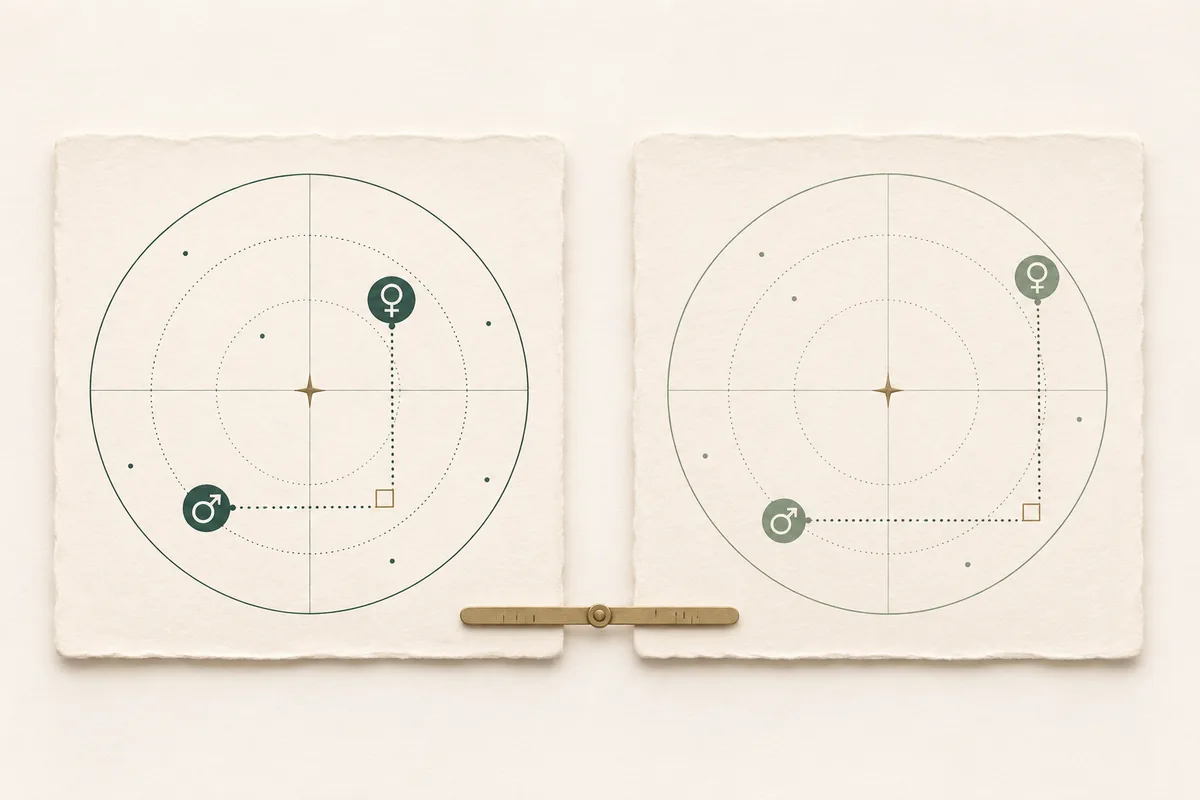
Astrological readings associate this square with attraction and friction, without measuring either person’s experience. The calculation answers a narrower question: are there two qualifying contacts, and how far is each from an exact square? An orb is the angular distance from the exact aspect, not a score for affection or sexual satisfaction.
The test
I fetched Venus and Mars longitudes for six UTC instants from Astrodienst’s official Swiss Ephemeris test service. Every date uses 12:00 UTC; calculations retain returned precision despite six-decimal displays. These deliberately selected daily-scan pairs illustrate patterns; they cannot estimate double-square prevalence. Six and seven degrees are comparison settings, not a universal allowance. These test timestamps represent neither real people nor fictional couples.
Unequal orbs
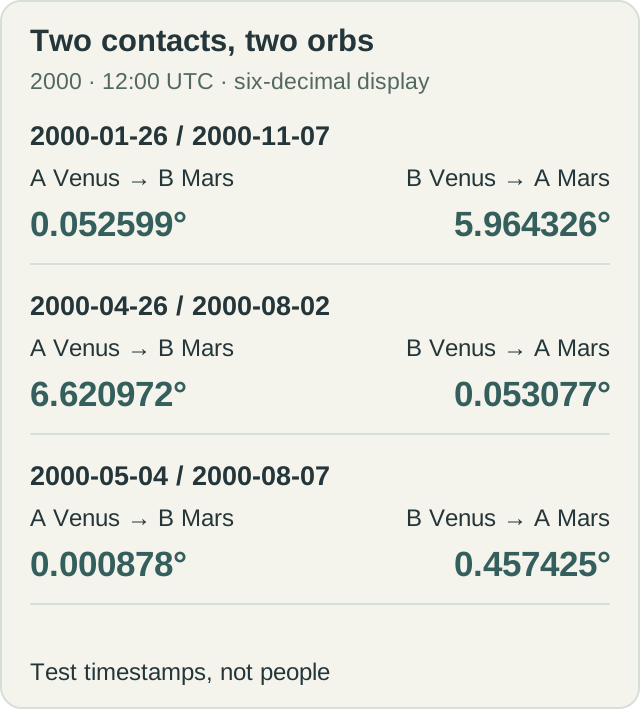
For January 26 and November 7, 2000, the first timestamp returned Venus at 272.051498° and Mars at 347.311095°, while the second returned Venus at 263.275420° and Mars at 182.104097°. First Venus against second Mars produced 89.947401° separation and a 0.052599° square orb. Second Venus against first Mars produced 84.035674° separation and a 5.964326° orb. Both contacts passed the inclusive 6° rule, although their unrounded orbs differed by 5.911727°. The wider contact lay 0.035674° inside that cutoff, while the narrower contact lay 5.947401° inside it.
One cutoff changes the count
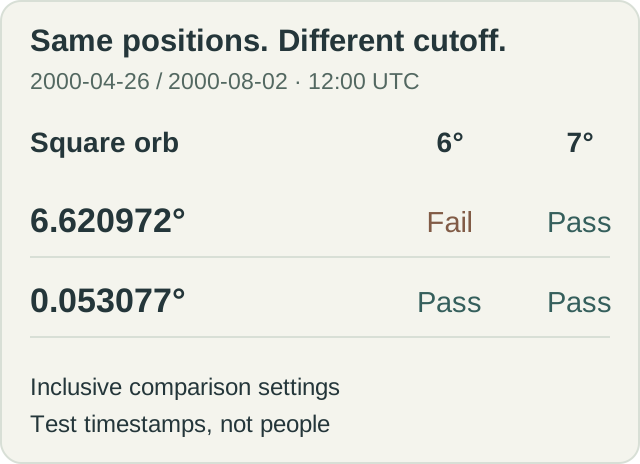
For April 26 and August 2, 2000, first Venus was 24.313984° and Mars 54.850052°; second Venus was 144.796975° and Mars 120.934956°. First Venus against second Mars yielded 96.620972° separation, giving a 6.620972° orb. Second Venus against first Mars yielded 89.946923° separation, giving a 0.053077° orb. At 7°, both qualified; at 6°, only the 0.053077° contact qualified, although neither timestamp nor planet position changed. Under the 6° setting, the wider contact exceeded the limit by 0.620972°, while the other remained 5.946923° inside.
Two tight squares
For May 4 and August 7, 2000, first Venus was 34.164382° and Mars 60.488333°; second Venus was 150.945758° and Mars 124.165260°. The two cross-contacts measured 90.000878° and 90.457425°, resulting in orbs of 0.000878° and 0.457425°. Both passed 6° and 7°, but their unrounded orb gap was 0.456547°, compared with 5.911727° in the January/November pair. Even its wider 0.457425° contact remained 5.542575° inside the 6° limit. The January/November and May/August tests each qualified twice under 6°, despite those different gaps between their two orbs.
Check your report
Check the report in front of you:
- Label your Venus, your Mars, their Venus and their Mars; keep each input date, time and time zone.
- Make two rows: your Venus with their Mars, then their Venus with your Mars; reversing one row adds no contact.
- For each row, reduce the longitude difference to the shorter angle, then subtract 90° and take the absolute value.
- Apply one written orb limit to both rows and record each pass or fail beside its unrounded orb.
- Compare reports by changing the allowance while keeping all four positions fixed.
Two questions
Can one report show a double square and another show only one? The April/August test shows exactly how changing a 6° allowance to 7° can produce that result. Does a tighter reciprocal orb show which person cares more? These geometric checks contain no test of anyone’s feelings, so they cannot answer that question.
Today, replace one bare double-whammy entry in your notes with two labelled orbs and the cutoff your report used.